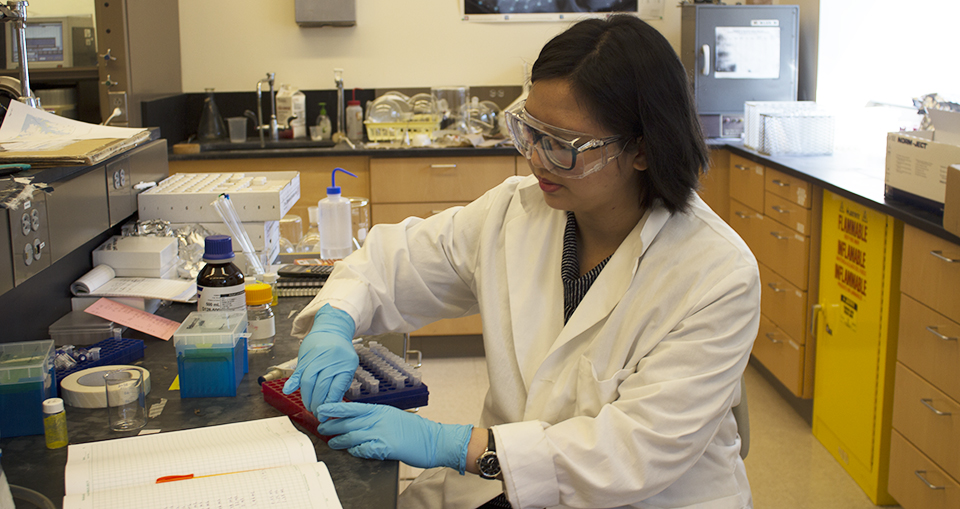
Manead Khin is a junior chemistry major conducting research under the direction of Dr. Nadja Cech, a professor in the Department of Chemistry. Khin’s project is titled “Identification of Antimicrobial Compounds from Macleaya cordata.”

Describe your project.
“My project mainly focuses on extracting bioactive compounds from Macleaya cordata, a plant in the poppy family, to find new treatments for MRSA (Methicillin-resistant Staphylococcus aureus). MRSA has become a serious threat that leads to around 11,000 deaths per year in United States alone.”
Findings so far?
“The initial crude extract has shown an inhibition rate of approximately 80% towards MRSA. The two fractions further obtained from this initial crude extract have demonstrated an inhibition rate of almost 100% towards wild type Staphylococcus aureus.”
What is the impact or significance of your project?
“The primary purpose of this project is to find new drug leads to treat MRSA. Finding treatments for MRSA is vital since MRSA is highly resistant to commonly prescribed antibiotics such as amoxicillin and penicillin. As of now, there has been no definite cure for the treatment of MRSA. This project, if successful, will be beneficial not only to patients facing MRSA infections but also to patients suffering from S. aureus-related infections and diseases.”
Have you disseminated the results of your project?
“I will be presenting at the Southern Conference of Undergraduate Research Forum in October 2017 and at the Southeastern Regional Meeting of the American Chemical Society in November.
What were some difficulties you ran into doing your project?
“For this project, the most challenging part was the choice of analytical methods. Since the project deals mostly with biological activity, it is important to choose a method that can efficiently extract the target bioactive compound from a mixture of many different organic compounds.
“The project has become more interesting over time since the bioactivity of the fractions keeps going up after every fractionation.”
How do you think participating in undergraduate research has benefited you as an individual?
“Science is not just about reading the books or taking the exams. It is about learning how the world works.
“Science for me is a hands-on experience. I am able to apply what I learned from lectures in the real science world, surrounded by professional scientists. By doing research, I am able to learn chemistry from many perspectives.
“It has also assisted me in understanding science better and keeps me a step ahead of other students.”
Was there an individual who you found particularly inspiring?
“My mother has always been a big plant lover. She loves gardening, and I grew up being surrounded by different plants. So, I naturally became interested in plants. My understanding is that the primary drug source for humans is plants.
“During my freshman year at UNCG, I had a tutor for General Chemistry. She was the first person to tell me that there were research groups on campus and suggested that I should join one.
“Becoming a research-physician has always been my passion, so, I decided to join the Cech Research Group which is a medicinal and analytical chemistry-based research group. I decided to work under Dr. Cech since her research is mainly associated with plants and medicine, which was exactly what I wanted to do.
Are you using unique or interesting methods, equipment, or tools?
“The most interesting techniques for me are bioassays, mass spectrometry, and NMR.
“Bioassays are methods that allow us to test the bioactivity of the compounds toward the intended bacteria. This method helps us in deciding which fraction to further test on.
“Mass spectrometry is a way to identify the mass, UV absorption, and abundance of the contents in a certain fraction.
“Finally, NMR is very unique as it provides the molecular structure of the final compound.”
What was the most surprising thing about this experience?
“It is very surprising for me to see how the follow-up fractions became more bioactive than the initial crude extract. This is very promising, since it indicates that we are getting closer to isolating a single bioactive compound.
“Nowadays, it is very easy to go to a pharmacy and get the medicine we need. A small tablet of 1 cm, involves much more complex science than most of us could ever imagine. Doing this research has made me more interested to the field of chemistry.”
Interview by S. Grace Hutko
The URSCO blog helps UNCG’s undergraduate scholars share their work and impact with the world. Interested in sharing your work? Contact URSCO Director Lee Phillips at plphilli@uncg.edu or Office of Research and Engagement Media and Communication Manager Sangeetha Shivaji at s.shivaji@uncg.edu.